|
\\ Home Page : Pubblications
List of articles required.
Articles of 26/02/2004
Interview with Mike Heim
Mike Heim is a philosophy teacher author
of Electric Language (Yale U. Press, 1987, 1999), Virtual Realism (Oxford U.
Press, 1998), The Metaphysics of Virtual Reality (Oxford University Press, 1993.
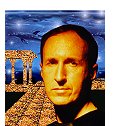
He currently teaches Virtual Worlds Theory and Virtual Worlds Design at the
Art Center College of Design in Pasadena, California
Mike kindly answered some questions on Computer Mediated Communication. Here
is our exchange.
R.C.:
Golem is a Hebrew word whose meaning is “shapeless mass”. According to a
legend, in 1560 Prague's rabbi Leone ben Bezabel moulded with clay a huge human
shape, that he called Golem. The creature, that could be animated writing the
word “emet” (truth) on his forehead, had to defend the Hebrews from the
persecutions. If the Golem threatened to rebel or to become too violent, it was
put back to sleep erasing the first letter of “emet” to change the word in “met”
(death).
In Hinduism one must be careful to stress correctly the word Rama in the Rama
mantra (endless repetition of the word Rama , a Hinduistic God) because if
during the chanting instead of invoking Ra ma- Ra ma- Ra ma (positive calling)
one, in the process of chanting, changes the stress and sings ra Ma -ra Ma -ra
Ma , the invocation of a celestial God becomes an invocation of Mara, the Lord
of death.
Such can be the power of language. In Neuro Linguistic Programming great
importance is given to reframing, that is giving another name to the same
experience in order to have a more ecological balance in the personality of the
individual. Switching words does not change the reality of things, but only the
way we live them.
In your writings you have very often pointed out the double nature of our
relationship with computers, in the sense that they both expand and limit
ourselves. I wonder if we can consciously limit the possible destructive side of
using ICT through the use of language, as we are told in the story of the Golem.
And of course, the other way round, if we could enhance holistically the
interaction with computers redefining the language that describes that
experience
MIKE
Yes, the language by which we address our use of computers is very important.
Like all vocabularies, the words by which we address the computer interface has
a poetic quality, by which I mean that such vocabularies reveal our
anticipations and feelings about what we are doing with a technology. As my late
friend and Renaissance scholar Ernesto Grassi was fond of saying, technology is
about humans and becomes humanized through our use of poetic metaphors like
"desktops," "windows," and "cyber- space ." In fact, we can perceive a range of
subtly shaded attitudes that show various attitudes that are contained in our
references to the Web. We notice different poetic (meaning “creative”)
possibilities in the choice of words.
Some people prefer the term "cyberspace" by which they reveal a tendency to
take computer networks romantically as areas for creativity, inhabitation,
self-expression, and belonging to a community. Others prefer to speak of
"information systems," a term that emphasizes the objective transmission of
electronic bits, a mathematically based signal/noise phenomenon that was
measured by Claude Shannon and the heirs of Leibnizean rationalists. Others
speak of "the Web" in the context of commercial activities like shopping,
financial transactions, and product displays that capture and hold attention
like a spider's web. Still others prefer "the Net" as they enjoy email, chat
groups, and networking with other people. All these language nuances are poetic
fictions that shape the way we use technology.
 These semantic variations are not simply matters of
hermeneutics or interpretation of what we all perceive. They do not interpret an
already given material reality. Rather, through these terms we conjure something
immaterial, something that exists in the dimension of symbolic impulses. To that
extent, we are conjuring in the realm of angels, in the non-material, higher
realm - "higher" because the computer environments maintain the possibility of
construing, affecting and then altering the physical worlds of time and space.
We can therefore speak of avatars as visitors from the angelic realm. In so
speaking about the avatar worlds of cyberspace, we are poetically conjuring a
role for ourselves as we enter and shape virtual spaces. The "angel" is
originally a messenger (angelos) who sees from a broader, higher viewpoint and
then brings that overview to those who dwell on lower planes and who are capable
of receiving that message. These semantic variations are not simply matters of
hermeneutics or interpretation of what we all perceive. They do not interpret an
already given material reality. Rather, through these terms we conjure something
immaterial, something that exists in the dimension of symbolic impulses. To that
extent, we are conjuring in the realm of angels, in the non-material, higher
realm - "higher" because the computer environments maintain the possibility of
construing, affecting and then altering the physical worlds of time and space.
We can therefore speak of avatars as visitors from the angelic realm. In so
speaking about the avatar worlds of cyberspace, we are poetically conjuring a
role for ourselves as we enter and shape virtual spaces. The "angel" is
originally a messenger (angelos) who sees from a broader, higher viewpoint and
then brings that overview to those who dwell on lower planes and who are capable
of receiving that message.
The poetic-angelic function of technology was long ago signaled in the
language used by the ancient Greeks who merged technical skills (techne) with
creative shaping (poesis). Technology and poetry, as Heidegger observed, belong
together. We do a disservice to this situation when we pretend that we are
passive victims at the mercy of a technology juggernaut. In fact, more than
ever, we look to the Renaissance as we foster the renascence of humanistic
poetry in the labyrinths of computer systems.
R.C.
“ The word museum derives from the Greek word for the Muses, goddesses of
dream, spontaneous creativity, and genial leisure. Virtual libraries and museums
should regain their original meaning. Museums are places for play, for playing
with the muses that attract us, for dreams, intuitions, and enthusiasms .”
(Metaphysics of virtual reality)
I'm particularly interested in Museums and Libraries as I've been asked to
design a few virtual museums using the technology Active Worlds. These museums
should allow visitors to see, in the same exposition, items that are physically
stored in different locations (some of them have never seen the light of a
public exposition), listen to sound textures that aim at communicating non
verbally the acoustic impact with the present and past culture of the place, do
things with the items and in the place, for example play games, scroll cartoons,
exchange opinions or just chat with other visitors.
I have appreciated your vision about the necessity to create just
standpoints, landmarks, giving as much importance to the blanks as to the pieces
of information displayed inside and around virtual imitations of real historical
buildings.
The voids in the fabric of the world should be designed so as to stimulate
the imagination of the users, that should integrate the pre-existing data with
their ideas, experiences, pre-concepts.
MIKE:
Dr. William Bricken, who created VEOS (Virtual Environment Operating System),
once said that his work at Washington's HIT Lab (Human Interface Lab)
sought to implement Buddhist "sunyata" (void, emptiness, non-fixation). Bricken
combined Emptiness with G. Spencer Brown's "The Laws of Form," which describes
the axioms that exist prior to creating any of the distinctions needed by any
system of logic. By preserving Emptiness, we invoke the spacious openness of
early Chinese Taoist-inspired nature painting. One approach to maintaining that
void of openness was discovered by my students at Art Center College of Design
(Pasadena, California). that his work at Washington's HIT Lab (Human Interface Lab)
sought to implement Buddhist "sunyata" (void, emptiness, non-fixation). Bricken
combined Emptiness with G. Spencer Brown's "The Laws of Form," which describes
the axioms that exist prior to creating any of the distinctions needed by any
system of logic. By preserving Emptiness, we invoke the spacious openness of
early Chinese Taoist-inspired nature painting. One approach to maintaining that
void of openness was discovered by my students at Art Center College of Design
(Pasadena, California).
In 1998, we developed some of our places in ActiveWorlds, one of which was
called "ACCD" world. In ACCD, we quite consciously removed the ground planes and
fixed horizons of virtual spaces, which was somewhat unusual at the time. Back
then, nearly all the worlds in the Activeworlds Universe were simulacra of
physical locations, three dimensional references to the world we already see
around us in conventional culture. Such conventional spaces may be easy to
navigate on first entry, but they fail to bring about the inherent fantasy of
this medium.
Instead of the conventional, Art Center students began with vast stretches of
void. From there they proceeded to build multi-level floating platforms for
specific kinds of navigation. Avatars became giant birds that fly freely between
the various platforms. One platform housed a Horse Heaven while another held
processions of fading brides. A pottery garden existed next to a giant sphere
that held within it another vast world of golden Renaissance domes where we
often held public chat meetings for our CyberForum@ArtCenter series.
Our profusion may have been excessive, but at the time we wanted to highlight
the possibilities that were covered by conventional expectations. Our next step
was then to seek functionality in combination with fantasy, the sharpening of
imagination through its application to human needs. Why couldn't a business
meeting online inject fantasy into collaborative activities? Fun should not
crush serious purpose, but why couldn't work regain some of the spontaneous
humor of play. Angels and avatars achieve their goals with less friction and
with greater lightness of being.
R.C.
“Cyberspace can cast a spell of passivity in our lives. We talk to the
system, telling it what to do, but the system language and logic come to govern
our psychology.” (Metaphysics of virtual reality)
How could we change this impasse? One way I ‘m experimenting with my students
is to integrate different languages in the same experience. If we start and end
our activity within the digital world, then our only reference is the logic of
that system, and we cannot but be conditioned by it.
 But if we plan things in a way that also the logic of the body, the
logic of non-digital artistic creation is included, then the final product will
be a result of the co-presence of different ecologies, different logics. But if we plan things in a way that also the logic of the body, the
logic of non-digital artistic creation is included, then the final product will
be a result of the co-presence of different ecologies, different logics.
The project Dance and hyperlink History started with a search of the
necessary information, both in books and in the Web, but the students were asked
to play with data and integrated historical data with fiction and humour.
MIKE
Yes, one of the highpoints of the CyberForum series was a two-day event held
on the campus of UCLA on November 29, 2000. The events combined physical dancers
and avatars, kung-fu artists and virtual telepresence interaction. We used the
"Visualization Portal" at UCLA and also the Electronic Arts Building (EDA). The
Visualization Portal houses a giant screen for wrapping viewers in a 3D
projection that arcs through part of the room. For the events, we projected
specially designed avatar worlds (Activeworlds) while at the same time an
audio-video Quicktime signal feed into the Internet to show our physical bodies
standing and moving against the avatar screens projected on the surrounding
wall.
Our physical bodies synchronized gestures and movements with the images on
the wall, thus responding and leading the movements of avatars who were in real
time present in the avatar worlds. Participants from around the world could then
interact with us through their avatars as they could see us physically dance or
perform kung-fu kicks with their avatars. An avatar in Sweden danced with a
physical body in Los Angeles that was also dancing with an avatar in Australia.
The lag time between all these experimental pieces of network technology was
about four seconds - just acceptable enough to make the event quite thrilling!
Had we had more time to experiment, we would have most likely reduced the lag
time even further.
The crew of a half dozen technicians supporting the events marveled at the
feeling of participatory world dance. Your dance experiments would make a nice
comparison with what we were doing during in those days. To experiment today
belongs to the essence of interactivity. Where most contemporary social
organizations, such as businesses and schools, are preoccupied with stable
revenue and controlled income, artists are not about “business as usual” and can
take the risks necessary for reversing the passivity of broadcast media.
 In doing so, art becomes a true “avant-garde” by
showing business and education how to move from the broadcast-industrial era
into the era of interactivity with information. It is not only the pathways we
discover that are important but the very path itself. Business and government
also need to learn from the nimble footed dance of interactive artists. In doing so, art becomes a true “avant-garde” by
showing business and education how to move from the broadcast-industrial era
into the era of interactivity with information. It is not only the pathways we
discover that are important but the very path itself. Business and government
also need to learn from the nimble footed dance of interactive artists.
R.C.
“ The monad sees the pictures of things and knows only what can be
pictured .” In other words, we can only know what can be translated in the
language of the computer. Referring to the infomania syndrome, you wrote: “
a gain in power at the price of our direct involvement with things. ”
(Metaphysics of virtual reality)
A direct experience is obviously rich in overtones that the rational mind can
not easily detect, also because much of the communication among humans is non
verbal, and the information we exchange through ICT is heavily textual and, in
second instance, visually oriented.
If ICT becomes the major source of our education, we'll become quantitatively
more knowledgeable but qualitatively less educated.
In the process of translation something will be missed or changed.
“ Today's computer communication cuts the physical phase out of the
communication process .”
It's interesting how from a similar root the two apparently separated words
translate and betray have arisen:
betray = from Middle English bitrayen, from Old French trair
, from Latin tradere , to hand over
translate = from Middle English translaten , from Old French
translater , from Latin translatus , past participle of
transferre , to transfer.
MIKE:
By remaining alert to the betrayal of computer communication, we can perhaps
develop richer, multi-layered applications for networked avatars. Our avatar
angels should remain aware of their need to include face-to-face bodily
communication as they project messages to earthly realms. Let me give you an
example. Recently we began planning an International Avatars Initiative ( http://cyberforum.artcenter.edu )
which intends to engage youth in conflict zones, such as the kids in Israel and
Palestine. Game-like encounters would establish virtual links among physically
and culturally separated participants, each inside personally designed avatars
that express the divergence and connections of their cultural heritages.
Our first plan involved mainly online meetings along the lines of the
CyberForum series 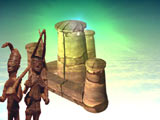 (1998-2000).
But soon we realized that the personal presence and interaction of living
mentors is an essential component, in this case, the engagement of college
students who could mentor, facilitate and guide the kids at disparate physical
locations. The college students would mentor the younger kids (8-16 years of
age) in creating avatars and in participating in online avatar meetings with
other kids. A helping environment, such as hospitals and schools, seemed the
right physical base for the mentors, who would assist in communicating the
angelic messages of openness and sharing that these "avatar encounters" can
foster. So the bodily presence of mentors became an integral component of the
Avatars Initiative. (1998-2000).
But soon we realized that the personal presence and interaction of living
mentors is an essential component, in this case, the engagement of college
students who could mentor, facilitate and guide the kids at disparate physical
locations. The college students would mentor the younger kids (8-16 years of
age) in creating avatars and in participating in online avatar meetings with
other kids. A helping environment, such as hospitals and schools, seemed the
right physical base for the mentors, who would assist in communicating the
angelic messages of openness and sharing that these "avatar encounters" can
foster. So the bodily presence of mentors became an integral component of the
Avatars Initiative.
More recently, we discovered the existence of the Intel-sponsored PC
Clubhouses in Los Angeles. The Clubhouse already provides a physical location
for mentoring youth in underserved communities who then benefit from learning
computer skills through the help of mentors. The Clubhouse has branches
extending around the world. We have yet to see how well we can establish nodes
in undeveloped countries of the world, but we have already found broad
expressions of interest from such service agencies as hospitals. We may even
connect with groups like the Peace Corps.
Right now, the International Avatars Initiative is in its infancy, but the
very concept seems to require the establishment of grounding physical locations
where the angelic intervenes in the earthly, integrating virtual identity
transformations with face-to-face hospitable meetings on the ground.
R.C.
Our virtual counterparts are without the qualities that make us human, i.e.
being fragile, non always certain of what to do, at times emotionally
unbalanced, and so forth. Those characteristics are the first we communicate
non-verbally when we meet another person. What happens in a virtual meeting is
that we choose as our ambassador to the foreign country artificially beautiful,
lifelessly imposing dolls. But “ they can never really represent us ”
MIKE
Like the masquerade party, avatars hide part of ourselves while those same
masks permit the expression of parts of ourselves which we normally choose to
hide, which we shy away from representing in conventional contexts. Online
multi-user meetings are about the interplay between hiding and revealing.
Remember that conventional society is already a highly evolved and subtle system
of restraints that channels specific social transactions, that limits while
making possible our human exchanges.
 Moral history is a process of refining and subduing
our self-presentations. So conventional social life is a context for neither
"pure self-representation" nor for direct self-expression. Even the clothing we
wear every day has gone through a design and stylization process by commercial
marketers. Avatar encounters do indeed put restraints on our
self-representation, but it is just a different shift from the normal
restraints. The shift provides new opportunities for using conventional
“personae” or masks. (The origin of the word “personality” lies in the word for
“mask.” The Latin “persona” derives from “personare,” which means to amplify
one's voice, as in Ancient Civilization the actors on stage used masks as
mouthpieces to project sounds throughout the large amphitheaters). Moral history is a process of refining and subduing
our self-presentations. So conventional social life is a context for neither
"pure self-representation" nor for direct self-expression. Even the clothing we
wear every day has gone through a design and stylization process by commercial
marketers. Avatar encounters do indeed put restraints on our
self-representation, but it is just a different shift from the normal
restraints. The shift provides new opportunities for using conventional
“personae” or masks. (The origin of the word “personality” lies in the word for
“mask.” The Latin “persona” derives from “personare,” which means to amplify
one's voice, as in Ancient Civilization the actors on stage used masks as
mouthpieces to project sounds throughout the large amphitheaters).
Avatars provide new channels for resonating the personality, which has never
been a socially “pure” personality anyway. The artist's task is to discover and
facilitate these new channels. No human encounters are perfect "mind melds"
(Star Trek). Our human encounters are always mediated by bodies with their
culturally shaped gestures and language. The facilitation of avatar encounters
is a performance art that acts as an advance outpost for new kinds of cultural
encounters.
Herein lies the importance of the moderator in virtual communities. The
moderator fosters new kinds of “manners” that are needed for online society –
manners which should not be confused, of course, with conventional politeness.
One lesson learned through the CyberForum series is that virtual encounters
require for their success a team of highly focused moderators who can work
within a pre-defined time frame. Worlds should not be open-ended if they intend
to create avatar encounters, as opposed to casual meetings.
The focused event can create customized environments that visually and
ritualistically support performances. Encounters cannot be left to chance. There
is an art of encounters. A moderator can facilitate the event so that encounters
can happen. Otherwise avatars may fail to discover what only avatars can reveal.
The avatar moderator must combine the skills of the painter and theater director
with the insight of the psychotherapist. Moderators are crucial if avatar chat
is to evolve its media-specific message and if angels are truly to appear.
R.C.
“ A virtual world needs to be not-quite real or it will lessen our
imagination .” (Metaphysics of virtual reality)
In French literature there is an example of hyper-realism in the XIX century
that can be a good illustration of where Virtual Reality might take us if we are
not aware of the psychological consequences of its use. In 1865 two French
brothers, Edmond and Jules Gouncourt, wrote Germinie Lacerteux, a story of a
woman and her slow degradation. In certain pages of their novel they reach
interesting effects by the mere listing of details perceived by their heroine,
during a promenade in Paris and in the neighbourhood. They aim at represent
realistically the visual impressions of the woman as she walks. Their detailed
descriptions, originally intended to be a trustworthy portrait of the reality,
transform the reality into a fantastic world. This narrative example shows how
an extreme realism leads but to fantasy, to an hallucinated/distorted perception
of the physical setting.
MIKE
The fictional story you describe is unfamiliar to me but it sounds
fascinating. At present, I am of two minds about the issue of “realism.” When
writing my book “Virtual Realism,” I conceived virtual reality as having a style
of its own, a style that combines fantasy with functional realism. Such a style
would use the reins of goal-oriented, time-limited focus to constrain the
wilderness of fantastical imagination that seems popular in much computer
graphics. Such a style also mediates two tendencies manifest in our cultural
psychology: the naïve realists, who tend to have a Luddite hostility to
technology; and the network idealists, who advocate information technology as a
panacea.
I still subscribe to the general definition of virtual realism, but I would
now want to supplement the definition with much material that has come to my
attention more recently. Since writing that book, several experiences have
unsettled the outlines of my earlier views. The synthespians in the movie Final
Fantasy, for example, add new insights into the potential of hyper-realism. And
since that 1998 book, the study of avatar graphics has opened my eyes to the
ability of movement, ritual, and chat to invest meaning in online multi-user
virtual reality (OMVR). We are now at an incredible turn in aesthetics when
multi-user 3D graphics gains every day in usability and significance.
R.C.
In discussing the relevance of the thought of Leibniz to our contemporary
minds you highlights his ideal of creating through scientific language a common
language aimed at allow people to communicate.
” He advocated a universal system of symbols for all the sciences, hoping
that a rational scientific language might smooth the way toward international
cooperation .” (Metaphysics of virtual reality)
 That reminds me of one specific technique used in the
mediation of conflicts. The presence of conflicts is a natural phenomenon, and
it is also natural to reduce or eliminate the destructive impact they have on
our lives. A mediator is a neutral person that after having listened separately
to the two conflicting parts, has them meet and agree on certain common basic
issues. One way a mediator can re-establish the broken communication is to
listen to the metaphors used by each of the two parts and then use them
consciously to make the two parts literally see, hear or touch what they have
not being able to realize in the previous conflictual period. That reminds me of one specific technique used in the
mediation of conflicts. The presence of conflicts is a natural phenomenon, and
it is also natural to reduce or eliminate the destructive impact they have on
our lives. A mediator is a neutral person that after having listened separately
to the two conflicting parts, has them meet and agree on certain common basic
issues. One way a mediator can re-establish the broken communication is to
listen to the metaphors used by each of the two parts and then use them
consciously to make the two parts literally see, hear or touch what they have
not being able to realize in the previous conflictual period.
It could be possible that advantage of having a new common language, created
thanks to the use of computers, could be to have people of different cultures
translate their ideas and needs using the same icons, metaphors when they
communicate one another.
This might allow for a better understanding of different needs and views.
MIKE
You raise questions here that touch quite directly on the International
Avatars Initiative. What I said above appears in more practical terms on the
website (www.mheim.com/iai )
 To Article To Article  All Articles All Articles  Print Print
Guidelines for Creative Educational Projects Design
Guidelines for Creative Educational Projects Design
For many Computer Technology is fascinating. “We love the simple, clear-cut linear surfaces that computer generate. We love the way that computer reduce complexity and ambiguity, capturing things in a digital network, clothing them in beaming colours, and girding them with precise geometrical structures”.**
 When we use a computer we “feel augmented and empowered”. Of course when things go well (when everything works well), because whenever a system crashes we face all our fragility and impotence. The system may crash at exactly the wrong moment. In that case we feel betrayed, abandoned, lost. As someone said, a crash reduces your expensive computer to a simple stone. When we use a computer we “feel augmented and empowered”. Of course when things go well (when everything works well), because whenever a system crashes we face all our fragility and impotence. The system may crash at exactly the wrong moment. In that case we feel betrayed, abandoned, lost. As someone said, a crash reduces your expensive computer to a simple stone.
But everything has got a price. “A gain in power (is) at a price of our direct involvement in things.” First of all, computer technology “can cast a spell of passivity on our lives. We talk to the system, telling it what to do, but the system's language and processes come to govern our psychology. We begin as voyeurs and end by abandoning our identity to the fascinating system we tend.”
Another limit is that “computers communication cuts the physical face out of the communicational process.” In so doing it cuts most of the non verbal levels the communication act, reducing it to the textual and iconographic content. It is not only a limit of the medium, but involves more personal and ethical issues.
“The living is the primal source of responsibility, the direct, warm link between private bodies. Face-to-face communication supports a long-term warmth and loyalty.” **
What we produce for the web, our interaction with e-mail or forums, appear not as the  product of our whole personality, but by the “persona” we have created in a web exchange. product of our whole personality, but by the “persona” we have created in a web exchange.
When we are in a physical communicative act, both parts involved know that we and what we say will be lost, that our actions are unique, and we must take care of the visual reaction of the other whilst we are communicating in order to adjust what we say.
Another limit is that the body has an intelligence of its own that must be taken into account, if we want to consider a total communication and learning environment.
Influence of Computers on Human Psychology
Let's question the initial statement and ask again why we are so fascinated with computers.
Something must happen whenever we sit and start digiting words and numbers onto the screen or actions are triggered by the gentle click of a mouse.
The so-called “Pet-therapy” exploits the beneficial influence of the proximity of an animal to a human being to treat diseases.
The simple proximity of a horse, a dog or a dolphin induces in the patient a sense of relaxation.
We might wonder what happens to us in the proximity of or even in the fusion with a computer.
 According to John Susan in his MOM, DAD, COMPUTER TRANSFERENCE REACTIONS TO COMPUTERS “users may rely on their computers to clarify and strengthen their sense of identity. (…) As users customize its hardware and software, the computer becomes more and more like a responsive reflection at their needs, feelings and ambitions. (…) By idealising it, by participating in all the amazing powerful things a computer can do, users strengthen their own confidence and feelings of success.” According to John Susan in his MOM, DAD, COMPUTER TRANSFERENCE REACTIONS TO COMPUTERS “users may rely on their computers to clarify and strengthen their sense of identity. (…) As users customize its hardware and software, the computer becomes more and more like a responsive reflection at their needs, feelings and ambitions. (…) By idealising it, by participating in all the amazing powerful things a computer can do, users strengthen their own confidence and feelings of success.”
It's well known that people say and do things while driving a car that they wouldn't ordinarily say or do when they are outside their vehicle. When they become one with a computer, users loosen up, feel more uninhibited, express themselves more openly. They reveal secret emotions, fears, states of mind. In their internet exchanges, they either show unusual acts of kindness and generosity or start using rude language and letting their anger spill on someone else.
Closed and open knowledge
Giorgio Stabile in “Paradigmi enciclopedici” has described the ways we can deal with new knowledge in two major possibilities: solving a puzzle and playing with the building blocks (Lego).
All the pieces of the puzzle have already been made, the only thing a user is allowed to do is to put them back together according to the original design. Behind the initial chaos of the “dispersed” pieces lies an underlying order that is to be reconstructed by the exact combination of one piece to another. It's a model of closed knowledge.
Another model for new knowledge is that that of building blocks, modular pieces of information that can be combined in any possible way. It begins with the construction of basic pieces of information that should be shaped in a modular way (with the possibility to be connected to a pre-existing block and to allow other blocks to be built upon it.
The limitation of the puzzle model and in general of the use of pre-existing models, designs, formats, etc. should lead us to limit the use of computer for educational purposes to only some stages, such as the initial data collection, the processing of data, and the final publication of the products.
Guidelines for designing open educational projects
If the major purpose of a project is the creation of new knowledge, some guidelines could be suggested.
A) Use a varied design approach to the project
Creative design strategies point out that it's advisable not to limit to a front to back or back to front approach (i.e. in the first case, starting from what you have at the beginning of a process and then consider what possible final outcome it might produce; in the latter, starting from the final outcome you want to achieve, then you consider what you need to achieve that goal at the start up stage.)
It should also be integrated a bottom top (i.e. considering the possibility of removing items or integrating new ideas) and a top bottom strategy (i.e. seeing the whole process from a distance and considering the whole thing with a detached mind).
B) Allow systemic integrations and changes
Instead of considering each single part in itself we should let all the parts rest together one next to the other and allow a natural systemic process of adjustment to take place. All things on earth change and develop in mutual influence, just because they are part of a system. Why shouldn't we allow the same possibility to the artefacts of our minds.
Just setting things one next to the other and allowing our systemic perception to start operating, viewing them as a whole and not as fragmented and isolated pieces of information is a powerful strategy for creating new knowledge. Some questions we might ask in order to start the integration process. ***
- What are the common ideas that all the parts share ?
- From a visual point of view, can some icons colours be changed in order to achieve a unity of style and message?
- From a content point of view, can the lack of information in one project be balanced by the abundance of data of another and vice versa?
- Can the content in a project be also used in another one, in order to achieve a more balanced production?
- Do we have sufficient resource to do it?
- What tools can be used?
- Is there another use for each tool/part?
- Can anything be replaced?
- Can we look at it from another angle?
- What is in a nutshell?
- How to subdivide the problem?
- Is there a first step?
- Dow do we feel about it?
- Do we like the way it is done?
- How would others think?
- What information is missing?
- What information do we like to have?
- How accurate are the sources?
- Are there enough facts / figures to support?
- What are the benefits of the project?
- What are the strengths?
- Can a higher target be set?
- What else can be added to it?
- What can be removed or compressed ?
- Are there any similarities between things that are different?
- Are there or can be underlined factors of repetition and progress?
- Can the proportions be changed?
- Can parts be rearranged?
- Can different sensory modes be combined?
- Can latent images be created in order to communicate subconsciously?
- Can any subject or idea be twisted to create new meanings?
- Is there any part that could be divided into smaller parts?
- Can we make fun of our subject?
- How can certain parts be imbued with symbolic qualities?

C) Introduction of elements of play
Play with words, with logical problems, the spatial organization of the items, introduce fictional spokespersons or commentators. Play with the rhythm of the narration and the alternation of visual, textual and audio content.
Roberto Cuccu
To Article All Articles Print
Second issue of 3D Fantasia
Welcome to the second issue of 3D Fantasia – Multimedia Educational Magazine . This magazine's mission is to provide a forum for reporting on people, events, technology, and issues involved in the use and study of Virtual Reality and Creative Multimedia Projects in Education.
A Virtual World is a world without limitation, a world as unlimited as dreams. It's also a world that's shared, like the physical world. The thing that's remarkably interesting to us about Virtual Reality is that you can make up reality and share it with other people. It's like having a collaborative lucid dream. It's like having shared hallucinations, except that you can compose them like works of art; you can compose the external world in any way at all as an act of communication.
 This issue of 3D Fantasia features an interview with the so-called “philosopher of the cyberspace”, Mike Heim . His books include Electric Language (Yale University Press, 1987, 2nd ed. 1999), The Metaphysics of Virtual Reality (Oxford University Press, 1993), and Virtual Realism (Oxford University Press, 1998). This issue of 3D Fantasia features an interview with the so-called “philosopher of the cyberspace”, Mike Heim . His books include Electric Language (Yale University Press, 1987, 2nd ed. 1999), The Metaphysics of Virtual Reality (Oxford University Press, 1993), and Virtual Realism (Oxford University Press, 1998).
In the same section on Virtual Reality, in “ From a 2D conceptual map to a temporal and spatial experience ” I discuss the implications of using 3D virtual reality in teaching Archeology to young students.
The section on Creative Educational Projects features some “ Guidelines on designing creative educational projects ”, and some “ New insights on the use of Multiple Intelligences in Education ”.
Digital writing hosts an article on the "Digital Reader" by Giovanna Zapu.
Finally, an introduction on “Online Simulation learning environment” will open a new line of research into one of the hottest area in the future of educational internet.
One last word on the new interface for the magazine. I've waited a long time before publishing another issue of 3D Fantasia, most of all because I was looking for new editorial forms of communication. The present interface allows readers to interact with the ideas discussed in the articles. It has a more dynamic content display of information.
Our vision for this forum, 3D Fantasia - Multimedia Educational Magazine , is to help, in a modest way, to explore and enrich the research and practice of educational projects based on a creative and innovative use of Internet. These new practices may lead the way towards a new approach to learning, based on multiple intelligences, constructivism, active and collaborative learning.
We invite you to read this new issue, and add your stories and experiences to what we publish here. Roberto Cuccu
To Article All Articles Print
26/02/2004

By Admin (pubblicato @ 15:38:36, vista 4600 volte)
Photographies Sections

By Admin (pubblicato @ 15:37:53, vista 4569 volte)
Photographies Sections

By Admin (pubblicato @ 15:37:10, vista 5379 volte)
Photographies Sections

By Admin (pubblicato @ 15:36:30, vista 8371 volte)
Photographies Sections

By Admin (pubblicato @ 15:35:36, vista 5769 volte)
Photographies Sections

By Admin (pubblicato @ 15:34:47, vista 4434 volte)
Photographies Sections

By Admin (pubblicato @ 15:33:52, vista 5728 volte)
Photographies Sections

By Admin (pubblicato @ 15:33:05, vista 5950 volte)
Photographies Sections

By Admin (pubblicato @ 15:32:29, vista 5579 volte)
Photographies Sections

By Admin (pubblicato @ 15:31:53, vista 4368 volte)
Photographies Sections

By Admin (pubblicato @ 15:30:51, vista 5037 volte)
Photographies Sections

By Admin (pubblicato @ 15:29:12, vista 5027 volte)
Photographies Sections

By Admin (pubblicato @ 15:27:37, vista 5826 volte)
Photographies Sections
|